Technical Brief
Grinder and Septic Systems – Pumping to Septic Tanks
Grinder and Septic Systems – Pumping to Septic Tanks.pdf
Onsite Sewage Systems (OSS), though seemingly simple in design, are an intricate, balanced
treatment system. A traditional OSS has three parts: the waste source, typically a home or
building not on municipal sewer, the septic tank, and the dispersal. Due to site limitations, we
sometimes use wastewater pumps which can impact the balance of the OSS. Pumping to septic
tanks is never ideal but keeping a few things in mind will help mitigate issues arising later.
The workhorse of an OSS is the septic tank. This buried storage tank receives raw waste from
the waste source. Bacteria naturally present in the human body go to work in the septic tank
to breakdown and consume biodegradable solids. This process is slow but thorough. Nonbiodegradable solids, as well as treatment byproducts, slowly accumulate on the bottom of the
tank. Fats, oils, and greases float to the surface. This material is known respectively as sludge and
scum and will remain until physically removed. What leaves the tank is a relatively clear liquid
known as effluent.
Equally important in the treatment process is the dispersal method, typically the effluent is
disposed into the soil; leach lines, mound systems, or drip irrigation are typical methods used
for dispersal. The soil is responsible for polishing the water and cleaning it to a point that it does
not harm any receiving body of water such as water tables, aquifers, wells, lakes, rivers, etc. The
soil accomplishes this by physical filtration via the pores of the soil and biologically by building
up microorganisms that feed on the harmful organics within the effluent. The type of dispersal
and size of the drainage field are typically driven by local codes and regulations, but in most all
cases are linked to soil classification, waste strengths, and the anticipated daily flow.
Though waste strength can be quantified in many ways, the two most common measurements
are 5-day biochemical oxygen demand (BOD5) and total suspended solids (TSS). BOD5 is the
oxygen demand to break down the organic waste over a 5-day period measured in mg/l (parts
per million) and quantifies the organic load of the waste. TSS is a measurement of inorganic
solids suspended in the waste also measured in mg/l. These are measured by labs as they are
too fine to be measured in the field. If the BOD5 levels become too high, the drainfield may be
inadequate to treat the effluent before it enters the surrounding environment. Additionally, the
microorganisms present in the soil can proliferate and cause a biomat to form. Excessive buildup
of a biomat can lead to a failed field caused by plugged soils and effluent ponding on the
surface. Similarly high concentrations of TSS can lead to the same failure with plugged soils and
effluent ponding. These waste strengths are directly tied to the sizing and balance of an OSS.

Due to elevation or difficult site conditions, wastewater pumps are commonly used in OSSs.
However, if proper precaution is not taken, they can throw off the balance of the overall treatment
process. Pumping to a septic tank is never ideal. The energy from pumped water can disturb
the settlement process within the septic tank and potentially result in higher waste strengths.
Grinder pumps can be particularly troublesome as they grind all solids into a fine slurry. This
slurry can create a suspension within the septic tank hindering the critical separation process of
solids, fats, oils, and greases from the effluent leading to higher concentrations of BOD5 and TSS.
To further emphasize how fine the debris can be, a typical centrifugal grinder rotates at 3450
RPM with a running clearance between the cutter and plate as low as four thousandths of an inch
(0.004”). This means a two-blade grinder would have over 100 cuts against the cutter plate per
second. The slurry produced by a grinder can hinder the separation process and reduces solids
to sizes smaller than what most effluent filters can catch. This could lead to higher strength
wastes and a failed field over time.
How bad could a grinder be? There has been little research done on grinders and their effect on
OSSs so it is hard to quantify. Most regulating authorities and design manuals have not taken a
hard stance against grinders, some still openly allow them. However, there has been extensive
studies on garbage disposals. While grinder pumps are not the same as garbage disposals,
they both reduce waste into fine particles. The US EPA Onsite Wastewater Treatment Systems
Manual states that homes with garbage disposals can see a 20-65 percent increase in BOD, 40-
90 percent increase in TSS, and 70-150 percent increase in fats, oils, and grease. This increase
in waste strength leads to additional accumulation and subsequent pump outs and increased
chance of plugged soils. Since several studies have been done on garbage disposals, many states
have written additional requirements into their regulations to combat high waste strengths and
the hinderance in the separation process. For homes that choose to use garbage disposals,
regulations typically require larger or additional tanks, larger drain fields, or alternative designs.
So, what can you do for applications where a pump is needed? The preferred option is to move
the septic tank so that it can be gravity fed from the waste source and pump the effluent to
the drainfield rather than pump the raw sewage to the septic tank. This option may require
preplanning by the plumbing contractor so that the primary discharge from the building is
suitable for gravity flow to a septic tank and/or require the septic tank be placed closer to the
building. For commercial systems with multiple buildings or sewage outlets, multiple smaller
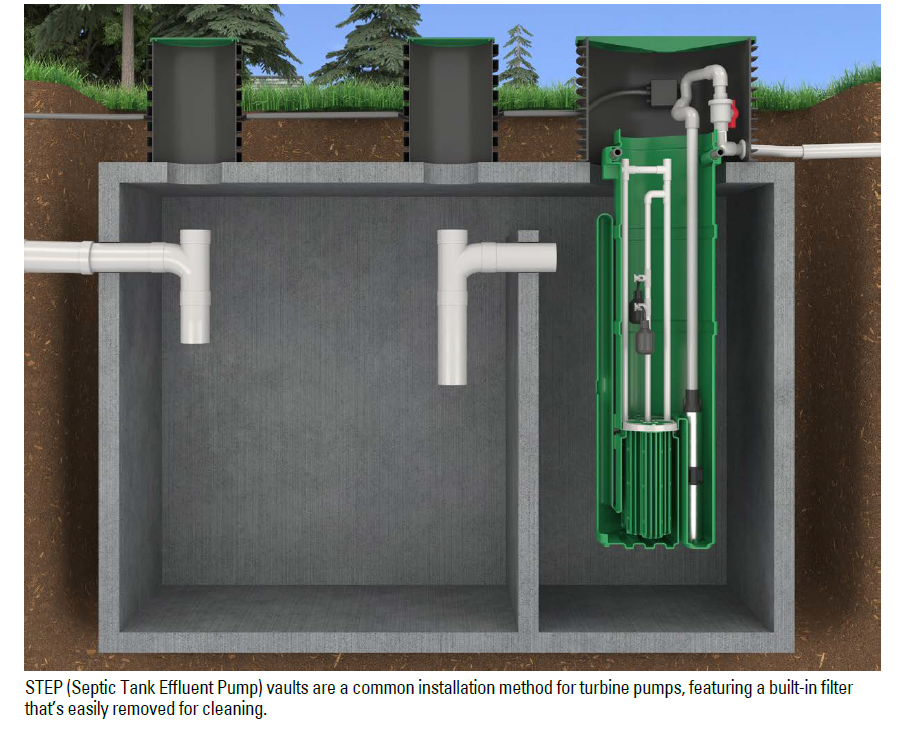
tanks can be used in place of one large septic tank, often referred to as a cluster system. Effluent
from cluster systems can be collected via pressure sewer with septic tank effluent pump (STEP)
systems and small diameter pipe. Gravity fed septic tanks eliminate the negative effects of
pumping to a septic tank and there are less limitations when pumping effluent. Effluent pumps
are typically less expensive, more efficient, and the removal of solids, fats, oils, and greases prior
to pumping leads to more reliable operation reducing overall life cycle costs.
In some cases, gravity flow to the septic tank is not feasible. In the instance where a pump is
needed to pump waste to the septic tank, the first recommended option is a solids handling
pump. Solids handling pumps are designed to pass solids through the pump. Passing solids
whole and intact will aid in the separation process within the tank. However, solids handling
pumps can be limited in their head capacities, therefore, in some cases a grinder pump may be
the more feasible option. Regardless of the pump used, the energy at which the water comes
into the tank is still a design concern. To help reduce the agitation within the septic tank, it is
recommended to pump up to grade ahead of the septic tank and transition to a larger diameter
gravity line that then feeds into the septic tank. Transitioning to a larger diameter gravity line will
reduce the velocity of the water entering the tank mitigating the disturbance within the septic
tank. Additionally, it may be wise to consider increasing the capacity of the septic tank, using
baffle walls, multi-compartments, and/or using a filter with a fine filter sock. All of which will help
increase the settling and reduce solids escaping the septic tank.
What about the effluent side? Some owners may have experienced a clogged effluent pump
and considered replacing it with a grinder pump, but this is not recommended. The downstream,
effluent side of a septic tank should not have any sizeable solids in the water. If solids are present,
it is an issue with the upstream process, not the pump selection. This effluent is discharged
directly to the soil, if solids are present, they will plug the soils over time. It is best to address why
the solids are passing through the septic tank rather than mask the problem with a grinder pump.
Common fixes would be pumping out the tank, adding or cleaning filters, increased capacity/
retention, owner education, and/or baffles.
In conclusion, which pump(s) you use in your OSS can vary based on the requirements of the
site. Zoeller offers best in class STEP Vaults, effluent, sewage, and grinder pumps. We have great
sizing tools and resources available online to help you size your own pump. You can also reach
out to one of our environmental product experts to help you understand the nuances of utilizing
pumps in your design for collection, treatment, and dispersal and what considerations need to
be taken.
Have questions?
Contact us at https://zoellerpumps.com/contact-us/